What Is a Sublimation Printer? Complete Beginner Guide (2026)
I still remember the first time a client brought me a mug they’d tried to make with a regular inkjet printer and some DIY kit they found online. The design was already peeling after one dishwasher cycle. They looked at me, frustrated, and asked, “Isn’t there a better way?”
There is. It’s called sublimation.
Let me paint you a picture: You’ve got a design—maybe your kid’s soccer team logo or a funny quote for your Etsy store. You print it, press it onto a shirt or a mug, and somehow, it becomes part of the product itself. No peeling. No cracking. Just vibrant color that stays put for years.
That’s what a what is a sublimation printer question is really about. It’s not just another printer. It’s a whole different way of thinking about printing.
Here’s what blew my mind when I first started: regular printers lay ink on top of stuff. Sublimation printers? They transform ink into gas and inject it into the material. We’re talking molecular-level bonding. That’s why those full-color designs on mugs and jerseys don’t wash out or fade like that sad mug my client showed me.
Quick story: Back in 2019, I had a customer who ran a small sports apparel shop. He was using heat transfer vinyl for everything—jerseys, banners, you name it. His biggest headache? The vinyl kept cracking after a few games, and parents were furious. We switched him to dye sublimation printing, and within six months, his reorder rate dropped by 80% because the stuff actually lasted. He called me last week to thank me again.
In 2026, custom printing 2026 isn’t just a nice-to-have. It’s everywhere. Small Etsy sellers are crushing it with personalized tumblers. Local sports teams want jerseys that don’t fall apart. Even corporate clients are ordering branded merch that actually looks premium.
But here’s the thing I tell everyone who walks into my workshop: the printer itself is just the starting point. I’ve seen people drop two grand on top-tier equipment and still produce garbage because they didn’t understand the process. And I’ve seen beginners with a converted Epson EcoTank create stunning work because they took the time to learn.
One more quick tip before we dive in: If you’re just starting out, run a printer test page before every big project. I know it sounds basic, but you’d be amazed how many headaches that simple step prevents. I had a client last month who wasted forty sheets of sublimation paper because they skipped this step and didn’t notice the print head was acting up. Forty sheets. Don’t be that person.
Over the past five years, I’ve helped dozens of small business owners launch their sublimation journeys. If there’s one thing I’ve learned, it’s this: understanding the process matters more than buying the most expensive printer.
So grab a coffee, and let’s walk through this together. I’ll share what actually works—including the mistakes I’ve already made so you don’t have to.
✅ Quick Summary
What is a sublimation printer? It’s a specialized printer that uses heat to turn solid ink into gas, which then bonds permanently with polyester materials or polymer-coated surfaces. Unlike regular inkjets that print on surfaces, sublimation prints into them—creating designs that won’t peel, crack, or fade. You’ll need sublimation ink, transfer paper, a heat press, and polyester-rich blanks to get started. Perfect for custom apparel, mugs, tumblers, and personalized gifts that actually last.
What Is a Sublimation Printer? Understanding the Core Technology
Now that you’ve seen what’s possible, let’s pop the hood and look at what actually makes these machines tick. Trust me—once you understand how this stuff works, the whole process starts making a lot more sense.
Simple Definition
A sublimation printer is a specialized printer that uses heat to transfer dye into materials, not onto their surface. The result? Prints that become part of the product itself.
I remember explaining this to a client who owned a small gift shop. She kept asking why her friend’s regular printer couldn’t just use sublimation paper and call it a day. I grabbed a plain white t-shirt and a polyester blend one from my rack. “Watch this,” I said. We printed the same design on both, pressed them, and washed them right there in my shop’s sink. The cotton shirt? Design looked like it survived a war zone. The polyester one? Perfect. Her face lit up. That’s when it clicked for her—and honestly, watching that moment never gets old.
Why Is It Called “Sublimation”?
The Science Made Simple:
Sublimation is the process where a solid turns directly into a gas—skipping the liquid phase entirely. You’ve seen this happen before. Remember those fog machines at Halloween parties? They use dry ice, which is solid carbon dioxide turning straight into gas. No puddle. No mess. Same principle here.
How It Applies Here:
Special sublimation ink, when heated to around 375-400°F, turns into gas and bonds with polyester fibers at a molecular level. Think of it like this: if regular printing is putting a sticker on a window, sublimation is dyeing the glass itself. The color becomes one with the material.
Key Difference from Inkjet:
This isn’t printing on the material. It’s printing in the material. No peeling, cracking, or fading. I’ve got samples in my workshop from 2018 that still look fresh. Try that with a regular iron-on transfer.
The Complete Sublimation System
Here’s something I wish someone had told me when I started: you can’t just buy a printer and call it a day. Dye sublimation printing needs a whole team of components working together. Miss one, and you’re in for a bad time.
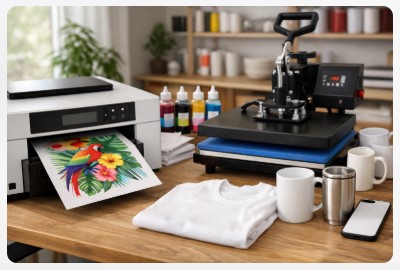
To get started, you need five components working together:
- A sublimation printer (or converted regular printer): Purpose-built ones like Sawgrass or Epson’s SureColor line are great. But I’ve converted more Epson EcoTanks than I can count for budget-conscious beginners. Works like a charm if you know what you’re doing.
- Sublimation ink: This isn’t your standard office supply stuff. Sublimation ink is specially formulated to turn into gas at high temperatures. Cheap ink? Don’t do it. I had a client try to save $20 on off-brand ink, and it ruined his print heads. The repair cost him $180. Sometimes saving money costs more.
- Sublimation transfer paper: Regular paper absorbs ink. Sublimation paper holds it on the surface until heat calls it to release. Different brands behave differently too. I keep three types in my shop because some work better for mugs, others for fabric.
- A heat press machine: You might see people using household irons on YouTube. Don’t. Just don’t. A proper heat press machine gives you even pressure and consistent temperature across the whole design. I learned this lesson the hard way in 2016 when I ruined a batch of fifty t-shirts with a $40 iron from a big box store.
- Polymer-coated or high-polyester materials: The substrate matters as much as the printer. For fabric, aim for at least 65% polyester. For hard items like mugs and tumblers, they need a special polymer coating. I test every new blank I order by running a quick sample before buying in bulk.
Here’s a pattern I’ve noticed with my small business clients: The ones who succeed long-term treat sublimation like a sublimation system, not just a printer. They understand that every component affects the final result. The ones who try to cut corners? They’re usually back in my shop within three months, frustrated and ready to quit.
I had a customer last year—let’s call her Maria—who started an Etsy shop selling personalized ornaments. She bought the cheapest printer, cheapest paper, cheapest blanks she could find. Three months in, she was ready to give up because nothing looked professional. We sat down, talked through each piece of the system, and she upgraded step by step. Now? She’s pulling in $4,000 a month during the holiday season and just bought a second press.
That’s the thing about this craft. When all five pieces work together, it’s honestly magical. When one piece is off? You’ll know immediately.
Epson’s official support page is where I grab driver updates, ICC profiles, and technical specs whenever I’m setting up a new printer for a client. It’s the most reliable source straight from the manufacturer—no guesswork, just facts.
How Does a Sublimation Printer Work? (Step-by-Step Process)
You know what’s funny? People walk into my workshop, see the printer and the heat press, and think it’s some kind of sorcery. It’s not magic—though I’ll admit, watching it work still gives me a little thrill after all these years. Let me walk you through exactly what happens, step by step.
Step 1 – Design and Mirror Image
First, you create your design in software like Canva, Photoshop, or whatever you’re comfortable with. Nothing fancy here—just get your artwork looking the way you want.
But here’s the step that trips up absolutely everyone at least once: you have to mirror your image. Flip it horizontally. Every single time.
Pro Tip: I once watched a client—smart guy, ran a successful print shop for years—ruin 20 sheets of sublimation paper because he forgot to mirror the text. Twenty sheets. He had a batch of custom team jerseys to deliver the next morning, and every single one said “GNIHTYREVE” across the back instead of “EVERYTHING.” We caught it before pressing, thank goodness, but he still wasted hours and materials. Always double-check before hitting print. Make it a habit. I literally say out loud “mirror check” every time I send a job.
Step 2 – Print onto Sublimation Paper
Load your sublimation paper into the printer—make sure you’re using the right side. Most papers have a coated side and a blank side. The coated side is where the ink sits.
The printer applies sublimation ink exactly where your design requires it. Now, here’s something that freaks out beginners: at this stage, the design looks dull. Muted. Kind of disappointing, honestly. I had a customer once call me in a panic because her test print looked “washed out.” She thought her printer was broken.
It’s not broken. That’s how sublimation works. The colors haven’t been activated yet. They’re just sleeping, waiting for heat to wake them up.
Step 3 – Prepare Your Material and Heat Press
Before you do anything else, preheat your material for a few seconds. Just a quick press—5 to 10 seconds—to remove moisture and wrinkles. Moisture is the enemy here. It can cause weird spots or uneven transfer.
Set your heat press to the correct temperature. This matters more than almost anything else:
- Typical Range: 350–400°F (175–205°C)
- Time Varies: Usually 45–60 seconds depending on material
Different blanks need different settings. Thicker materials take longer. Delicate fabrics need lower temps. I keep a notebook in my shop where I write down the perfect settings for every new blank I try. After five years, it’s basically a bible.
Step 4 – The Magic: Heat and Pressure
Place your printed paper onto the material, printed side down. Tape it in place if you need to—heat tape is cheap, ghosting is expensive.
Apply firm, even pressure with the heat press. And I mean even. Close it smoothly, not jerky. The heat activates the ink, turning it into a gas. This is the sublimation part—solid to gas, no liquid in between.
You’ll hear a little sizzle sometimes. That’s normal. That’s the sound of success.
Step 5 – Gas Injection and Permanent Bonding
Here’s where it gets wild. That gas penetrates the polyester fibers and bonds permanently. We’re talking molecular level. The ink becomes part of the material’s structure.
When you peel the paper off—while it’s still warm, usually—the design is now part of the product. Not sitting on top. Not glued on. Part of it. You can scratch it, wash it, stretch it. That design isn’t going anywhere.
I still grab samples from my “oops” pile sometimes—mistakes I made years ago—and wash them just to see. They hold up. Every single time.
Why Temperature and Pressure Consistency Matter
From My Experience: Beginners always underestimate consistency. They nail the temperature, nail the time, and wonder why their prints still look off-center or faded on one edge.
I had a client—great guy, started a small Etsy shop selling custom pet bandanas—whose prints were always faded on the left side. Just the left side. Drove him crazy. He replaced his printer, changed his paper, bought new ink. Nothing worked.
He brought his setup to my workshop, and I spotted it in about thirty seconds. His heat press platen wasn’t level. Off by maybe two millimeters. But that tiny gap meant the left side of his designs wasn’t getting full pressure. The gas couldn’t penetrate evenly.
A little adjustment with a level and some shims, and his problems disappeared. Cost him nothing but time. That’s the thing about how sublimation works—every variable matters. Temperature, pressure, time, material. They all have to line up.
I tell people this all the time: the heat press temperature for sublimation isn’t just a number you set and forget. It’s a relationship between your press, your material, and your environment. Humidity changes things. Altitude changes things. Even the age of your heating elements can shift results.
That’s why mirror image printing and sublimation process steps aren’t just checkboxes. They’re part of a system. When you respect the system, it rewards you with prints that look professional and last forever. When you skip steps or guess at settings? Well, that’s how you end up with fifty misprinted mugs and a very long phone call to someone like me.
I’ve lost count of how many times Sawgrass’s knowledge base pulled me out of a jam. Their troubleshooting guides walk you through color issues, print head cleaning, and software setup step by step. It’s like having their tech team on speed dial.
Next up, let’s talk about what you can actually make with this thing—because that’s where the fun really starts.
What Can You Print With a Sublimation Printer? (Materials & Products)
You know what question I get more than any other? Someone walks into my workshop, eyes wide, and asks, “Wait, I can put my designs on what?”
The short answer? A whole lot more than you’d think.
I had a customer last year—retired teacher, wanted to start a little side hustle—who came in convinced sublimation was just for t-shirts. We spent an hour walking around my shop, and I showed her sample after sample. Mugs. Tumblers. Mouse pads. Keychains. Ornaments. Her mind was blown about twelve times.
By the time she left, she had a list of twenty product ideas and a plan to hit the holiday market. She cleared $6,000 in November alone.
So let’s talk about what you can actually make with this thing.
Popular Product Categories in 2026
The market keeps expanding. Every year, manufacturers come up with new sublimation blanks—new shapes, new materials, new possibilities. Here’s what’s hot right now:
Apparel:
- Sports jerseys (polyester): This is the bread and butter of so many small shops. Local teams, school clubs, corporate softball leagues—everyone wants matching jerseys that don’t crack after the first game. I’ve got a client who does nothing but youth soccer jerseys, and she’s booked solid six months out.
- Custom t-shirts (must be 65%+ polyester): Higher polyester content means brighter, longer-lasting prints. I tell my clients to check tags before buying in bulk. That 50/50 blend shirt from the craft store? It’ll work, but the colors won’t pop like they do on 100% polyester.
- Leggings, tank tops, and activewear: The athleisure market is still going strong. Full-color designs on leggings? People go crazy for them. I had a customer who started making galaxy-print leggings for her friends. Now she sells at local markets and can’t keep up with demand.
- Pet bandanas and accessories: I’m not kidding—this category exploded. Dog bandanas, cat bow ties, even little pet sweaters. Owners love matching their pets. One of my clients does custom bandanas for dog birthday parties. Yes, that’s a thing. Yes, she makes good money at it.
Drinkware:
- Ceramic mugs: The classic. Perfect for gifts, corporate events, wedding favors. I’ve sublimated thousands of these over the years, and they never get old.
- Stainless steel tumblers (with polymer coating): These are everywhere in 2026. Yeti-style cups with custom designs? Sell like crazy. But here’s the catch—they need that special coating. Regular tumblers from the big box store won’t work. You need polymer coated mugs and cups made specifically for sublimation.
- Water bottles: Same concept as tumblers, different shape. Great for gym-goers, hikers, anyone who wants to stay hydrated in style.
- Shot glasses and wine tumblers: Perfect for bachelorette parties, weddings, holiday gifts. I have a client who does custom wine tumblers for bridesmaids. She charges $25 each, her cost is about $6, and she does twenty at a time.
Home & Office:
- Mouse pads: Easy to make, cheap to produce, always in demand. Great for corporate clients ordering branded merch.
- Coasters: Another fast seller. People love sets with matching designs. I sell blanks for about $1.50 each and see them retail for $15–20 for a set of four.
- Pillows and cushion covers: Full-color throw pillows? Yes please. These make great housewarming gifts and sell well at craft fairs.
- Tote bags: Reusable shopping bags with custom art. Eco-friendly and profitable. Plus, everyone needs more bags.
- Aprons: Cooks love personalized gear. Great for Father’s Day, Christmas, and culinary school grads.
Hard Goods:
- Phone cases (poly-coated): Tricky to get right, but once you nail the technique? Great margins. You need the right heat press attachment, but it’s worth figuring out.
- Aluminum panels and signs: Perfect for wall art, business signage, memorial pieces. The colors on metal are honestly stunning—they pop in a way that’s hard to describe.
- Keychains: Small, quick to make, easy to sell in bulk. Great impulse buy items at markets.
- Ornaments and puzzles: Holiday money-makers. I have clients who do 80% of their annual revenue in November and December just from ornaments. One woman sells custom family photo ornaments for $18 each and makes hundreds every Christmas.
Unique & Trending 2026:
- Custom skateboards: Not just for kids anymore. Adults collect them. One of my clients does custom decks for a local skate shop and can’t keep up.
- Pet ID tags: Personalized, durable, and pet owners always need them. Great repeat business—pets lose tags, people buy more.
- Graduation cap decorations: Huge business in May and June. Parents want to celebrate their grad with custom caps, and schools allow it as long as it’s not permanent. Sublimation on fabric caps? Perfect.
- Memorial plaques: Sentimental, meaningful, and customers pay a premium. I’ve helped clients create memorial pieces for beloved pets, lost family members, even favorite horses. It’s meaningful work.
Important Limitations
Okay, now for the reality check. I hate being the bearer of bad news, but I’d rather you hear it from me than learn it the hard way—like the customer who ordered 200 cotton t-shirts and couldn’t figure out why his prints kept washing out.
- ❌ Does NOT Work on 100% Cotton: Sublimation ink needs polyester to bond. On pure cotton, prints wash out and fade faster than you’d believe. I tested this once—ran a design through the wash ten times. The cotton shirt looked like a ghost. The polyester blend? Still perfect. Stick to polyester fabric for sublimation and save yourself the heartache.
- ❌ Requires Polymer Coating: For hard items like mugs and metal, the surface must have a special polymer coating. Regular ceramic from the dollar store? Won’t work. Stainless steel water bottle without coating? Nope. Always buy blanks specifically made for sublimation. I learned this the expensive way when I grabbed a pretty mug from a thrift store, spent time on a design, and watched it wipe right off.
- ❌ Not for Dark Materials: Sublimation ink is transparent. It works best on white or light-colored materials. Put it on a black shirt, and you’ll barely see it. I’ve had customers argue with me about this—”But I want black t-shirts!”—and I always tell them the same thing: sublimation isn’t the right tool for that job. Use vinyl or screen printing for dark fabrics.
Quick Tip: “Always test a small sample before committing to a bulk order. Different brands of sublimation blanks can give slightly different results. I learned this when I ordered 50 mugs from a new supplier and the coating was slightly off—ruined half my prints before I figured it out. Now I test everything first. Order one. Run a sample. Make sure it works before you commit to fifty.”
Here’s the thing about what can I sublimate on: the list keeps growing. Every year, manufacturers create new blanks—yoga mats, jigsaw puzzles, even dog bowls. The key is knowing what works and what doesn’t.
I’ve got shelves in my workshop filled with test samples from the past five years. Some worked beautifully. Some were total disasters. But every disaster taught me something, and now I know exactly what to recommend when a customer asks, “Can I put my design on this?”
Custom tumblers alone have paid for my equipment three times over. Polymer coated mugs are my bread and butter. And every time I discover a new blank that works well, I get that same thrill I felt when I first started.
Next up, let’s compare sublimation to regular inkjet printing—because understanding the difference might save you from buying the wrong printer entirely.
Sublimation Printer vs Inkjet: What’s the REAL Difference?
I can’t tell you how many times someone’s walked into my shop holding a regular inkjet printer box and asked, “Can I just use this for sublimation?”
The short answer? No. But the longer answer is way more interesting.
Let me break down what actually separates these machines—because understanding the difference might save you from making a very expensive mistake.
Quick Comparison Table
| Feature | Sublimation Printer | Regular Inkjet Printer |
|---|---|---|
| Ink Type | Sublimation dye (turns to gas) | Liquid pigment or dye |
| Target Material | Polyester & coated items | Paper (photos/documents) |
| Durability | Permanent (bonds with fibers) | Can fade, peel, or wash out |
| Print Feel | No texture—part of the material | Sits on surface, can be felt |
| Color Range | Excellent for vibrant, full-color | Good, varies by model |
| Flexibility | Limited to polyester/coated items | Very flexible (paper, canvas, stickers) |
Sublimation vs Heat Transfer Vinyl (HTV)
Now, here’s where people really get confused. They hear “heat transfer” and think it’s the same thing. It’s not even close.
| Aspect | Sublimation | HTV |
|---|---|---|
| Best For | Full-color photos, gradients | Solid colors, simple text |
| Feel | Soft (no texture) | Can be thick or rubbery |
| Durability | Won’t peel | May peel over time |
| Cotton Compatibility | No | Yes |
| Learning Curve | Moderate | Easy |
I had a client last year—let’s call him Mike—who ran a small print shop and wanted to expand into custom t-shirts. He bought a vinyl cutter first because it was cheaper. Made some nice stuff, solid colors, looked good. Then a local soccer team asked for jerseys with full-color player photos and gradients. Mike’s vinyl setup couldn’t handle it. He called me in a panic.
We talked through his options, and I showed him some samples of sublimation vs inkjet on polyester fabric. He saw the difference immediately. Those photo-quality prints? Only one winner.
Six months later, Mike’s doing all the local sports teams and just bought his second sublimation printer.
Sublimation vs Screen Printing
You might be wondering about this one too. Screen printing’s been around forever, and it’s not going anywhere. Here’s the deal:
Screen printing is king for huge batches—think 500 identical shirts. The setup cost is high, but the per-shirt cost drops fast. Sublimation wins for smaller batches, full-color complexity, and that soft feel customers love.
I tell people: if you’re doing 50 shirts with the same one-color design, screen printing might be smarter. If you’re doing 10 shirts with different player names and numbers and photos? Sublimation every time.
Which One Should You Choose?
Look, I’m not here to tell you one technology is universally better. They’re tools. You pick the right one for the job.
Choose Sublimation If:
- You want to create photo-quality, full-color products that look like they came from a factory
- You’re targeting the sports apparel or personalized gift market where customers expect durability
- You want prints that feel soft—like part of the fabric—and last forever without peeling
- You’re willing to learn the process and invest in the right materials up front
Choose Inkjet/HTV If:
- You primarily print on paper or 100% cotton items
- You need a simple, low-cost entry point and don’t want to deal with heat presses and coatings
- You’re doing small batches of simple designs with solid colors
- You want to print photos for scrapbooks or documents for the office
Here’s an insight from years in the trenches: “I tell my clients: if you want to sell $30 mugs that look premium and last forever, go sublimation. If you’re printing occasional t-shirts for a family reunion, HTV might be simpler and cheaper. But if you’re comparing sublimation vs screen printing for a big sports order, do the math on both—sometimes the old ways still win.”
The Real Talk About Conversion
One more thing I get asked constantly: “Can I convert my existing inkjet to sublimation?”
Yes, you can. I’ve done it dozens of times with Epson EcoTanks. But here’s the catch—once you put sublimation ink in that printer, it’s a sublimation printer forever. You can’t switch back and forth. The ink formulations are different, and mixing them ruins print heads.
I had a customer try to save money by using the same printer for documents and sublimation. Switched inks back and forth for about two weeks before the print heads clogged beyond repair. New printer cost her $300. The lesson? Pick one job per machine.
The Bottom Line
When you’re looking for the best printer for custom gifts, sublimation is hard to beat. The quality, durability, and professional finish just work. But it’s not the only tool, and it’s not right for every job.
If you’re doing full-color photo prints on polyester, sublimation wins. If you’re doing simple text on cotton, HTV might serve you better. If you’re doing 500 identical shirts, screen printing could be your answer.
Know what you want to make, then choose the tool that makes it easiest to get there.
Next up, let’s talk about whether this whole setup is actually worth the money in 2026—because I know that’s the question burning in your mind right now.
Is a Sublimation Printer Worth It in 2026? (Cost & Profitability)
Every single week, someone sits across from me in my workshop and asks some version of this question: “Tobby, is this gonna be worth my money, or am I just buying an expensive hobby?”
Fair question. Sublimation gear isn’t cheap, and I’ve seen plenty of people drop serious cash only to let their equipment collect dust.
So let’s talk numbers. Real numbers. Not the “you’ll be a millionaire by Christmas” garbage some YouTube videos promise.
The Real Startup Cost Breakdown
Here’s what you’re actually looking at to get started in 2026. I’ve updated these based on what my clients have paid over the past few months.
| Item | Entry-Level | Mid-Range |
|---|---|---|
| Sublimation Printer | $250–400 (converted Epson) | $500–800 (purpose-built like Sawgrass or Epson F100) |
| Heat Press | $150–250 (12×15) | $300–600 (swing-away, larger size) |
| Sublimation Ink | $40–60 (starter kit) | $80–120 (refill bottles) |
| Sublimation Paper | $30–50 (100 sheets) | $60–100 (bulk pack) |
| Starter Blanks | $50–100 | $100–200 |
| TOTAL ESTIMATE | $520–860 | $1,040–1,820 |
I had a customer last month—young guy, wanted to start selling at local flea markets—who tried to go even cheaper than my entry-level numbers. Bought a $100 heat press off some random website, used generic ink from Amazon, grabbed the cheapest blanks he could find.
Three weeks later, he was in my shop with a box of ruined shirts and a heat press that couldn’t hold temperature. He ended up spending more fixing his mistakes than if he’d just started with decent gear.
Don’t be that guy.
Profit Potential for Small Businesses
Okay, now for the fun part. What can you actually make?
Market Opportunity: The custom merchandise market keeps growing in 2026. Etsy, Amazon Handmade, local markets—everyone wants stuff that feels personal. I’ve watched this space explode over the past decade, and it’s not slowing down.
Ideal Customers I’ve Seen Succeed:
- Etsy sellers and print-on-demand creators: One of my clients does nothing but custom pet ornaments. Dogs, cats, even hamsters. She clears $3,000 a month just during the holidays.
- Local sports teams (jerseys, banners): Another client signed a deal with a youth soccer league. Every kid gets a personalized jersey. He does 500 jerseys a season at $35 each. Do the math.
- Small boutiques offering custom items: A women’s clothing shop near me started offering custom leggings. Now it’s half their business.
- Event planners (weddings, corporate gifts): Wedding favors alone can pay for your equipment in one season. Custom champagne flutes, koozies, place cards.
- Hobbyists funding their craft: This is where most people start. Make enough to cover your supplies, then grow from there.
Sample Profit Margins (Based on What My Clients Actually Charge):
- Custom mug: $5 cost → $20–25 sale price. I’ve seen mugs sell for $30 at craft fairs if the design is good.
- Personalized t-shirt: $8 cost → $25–35 sale price. Team orders are where this adds up fast.
- Tumbler: $10 cost → $30–40 sale price. Popular tumblers with good designs fly off tables.
Quick story: A retired teacher started coming to my workshops two years ago. She bought an entry-level setup, learned the basics, and started selling at local craft shows. First year, she made maybe $4,000 profit. Second year, she figured out which products sold best, refined her designs, and cleared $15,000. This year? She just rented a small booth at a permanent market. Not quitting her pension, but having a blast and making real money.
Sublimation business profit isn’t magic. It’s math. Sell enough mugs, and the printer pays for itself pretty quick.
The Learning Curve and Realistic Expectations
I’m not gonna sugarcoat this. There’s a learning curve.
- Not a Document Printer: Using your sublimation printer for everyday documents wastes expensive ink and can cause clogging. I had a client who “just wanted to print one quick thing” and ended up with a $200 repair bill. Keep your machines for their jobs.
- Color Management Takes Practice: What you see on screen isn’t always what you get. Monitors show colors differently than printers produce them. Expect to learn about ICC profiles and run test prints. Lots of test prints.
- Troubleshooting Is Part of the Journey: Ghosting, banding, fading—you’ll encounter them all eventually. I still do. But here’s the thing: every problem has a solution. And once you’ve solved it once, you know it forever.
The Best Printer for Beginners 2026
If you’re just starting, here’s my honest advice based on what I’ve seen work:
The Epson SureColor F100 is a solid purpose-built machine. No conversion needed, good support, reliable prints. Runs about $600–700. Worth it if you have the budget.
The Sawgrass SG500 is another popular choice. Comes with great software, though some folks find the subscription model annoying. Solid machine though.
If you’re budget-conscious, a converted Epson EcoTank (like the ET-2800 or ET-15000) can get you started for under $300. I’ve converted dozens of these. They work great. Just know you’re taking on some DIY responsibility.
Here’s the thing about sublimation startup cost: you don’t have to buy everything at once. Start with a printer and a basic heat press. Learn on mugs and shirts. Add more blanks and better equipment as you grow.
Balanced Perspective:
I won’t tell you this is a “get rich quick” path. It’s not. I’ve seen people quit after three months because they thought money would just appear.
But after the learning curve? When you hold that first perfect mug—the colors vibrant, the design sharp, the customer thrilled? That feeling is real. And I’ve seen hobbyists turn this into full-time incomes within a year. Not because it’s easy. Because they stuck with it.
One of my best clients started in her garage with a converted printer and a $150 heat press. Three years later, she has a storefront, two employees, and more orders than she can handle. She still calls me when something breaks. But she’s not calling to ask if it was worth it.
Next up, let’s talk about the mistakes I see beginners make most often—and how you can avoid them entirely.
Common Sublimation Mistakes & How to Fix Them (Troubleshooting)
You know what separates successful sublimation folks from the ones who quit? It’s not talent. It’s not even good equipment. It’s knowing how to fix things when they go wrong.
And trust me, things will go wrong. I’ve been doing this for over a decade, and I still have days where I want to throw my heat press out the window.
But here’s the good news: almost every problem has a fix. You just need to know what to look for.
Problem: Faded or Dull Print After Pressing
This is the number one complaint I hear. Someone spends time on a design, presses it perfectly, and… meh. The colors look like they got tired halfway through.
Why It Happens:
- Temperature too low (the ink didn’t fully gas)
- Pressure too light (poor contact between paper and material)
- Time too short (didn’t complete the transfer)
- Wrong material (cotton instead of polyester—this one gets people constantly)
The Fix:
First, verify your temperature with an external thermometer. Those built-in gauges on cheaper heat presses? I’ve seen them be off by 50 degrees. I use a handheld infrared thermometer and check my platen before every big job.
Increase pressure until you feel real resistance when closing the press. You want the material compressed, not just touched.
Extend press time by 10–15 seconds and see if that helps. I keep a notebook where I write down the perfect settings for every blank I use. After a while, you build a reference.
And check that material composition. If it’s less than 65% polyester, you’re fighting a losing battle.
I had a client last month who couldn’t figure out why is my sublimation print faded no matter what she tried. I looked at her shirt tag. 50% cotton, 50% polyester. Switched her to 100% polyester blanks, and suddenly her prints looked amazing. The material wasn’t wrong—it just wasn’t right enough.
Problem: Ghosting or Blurry Image
Ghosting looks exactly like it sounds—a faint, shifted duplicate of your design. Like a ghost version standing next to the real thing.
Why It Happens: The paper shifted during pressing. Even a millimeter of movement while the ink is gassing can create that double image.
The Fix:
Use heat-resistant tape on all edges. Don’t be stingy. I use at least four pieces on a standard shirt, more on tricky items.
Close the press quickly but smoothly. A slow close gives the paper time to shift from the air movement. A fast, jerky close can bounce it. Find that sweet spot.
For hard-to-stick items like curved mugs, consider a tacking iron. It’s a little wand that applies just enough heat to tack the paper in place before the full press. Game changer for drinkware.
Problem: Banding (Lines in the Print)
You know those horizontal lines across your print, like a really bad scan? That’s banding. And it’s infuriating.
Why It Happens:
- Print head nozzles are clogged (most common)
- Ink is running low (air gets in the lines)
- Print head needs alignment (mechanical issue)
The Fix:
Run a nozzle check from your printer software. If you see gaps in the test pattern, run a head cleaning cycle. One or two cleanings usually does it. More than that and you’re just wasting ink—let it rest for a few hours if it’s stubborn.
Check your ink levels. Low ink can cause air bubbles that mess with flow.
Perform a print head alignment from your printer settings. This calibrates the mechanical movement and can fix subtle banding.
Sublimation banding is almost always a printer issue, not a pressing issue. Get that sorted first before you blame your heat press.
Problem: Uneven or Patchy Colors
Parts of your design look great. Other parts look washed out. What gives?
Why It Happens: Inconsistent pressure across the item. Your heat press isn’t making full contact everywhere.
The Fix:
Check if your heat press platen is level. I use a simple bubble level. If it’s off, you might need to shim it or adjust the pressure mechanism.
Use a butcher paper pad to distribute pressure more evenly. Fold some butcher paper into a pad and place it under your material. It helps fill small gaps.
For mugs, ensure even contact with the heating element. Those mug presses can be finicky. I sometimes use a silicone band to help hold everything tight.
Problem: Ink Bleeding or Smudging
The edges of your design look fuzzy. Colors bleed into each other. It’s messy.
Why It Happens: Too much ink, wrong paper, or handling before pressing.
The Fix:
Reduce ink density in your design settings. Sometimes we get heavy-handed with saturation. Back it off 10–15% and see what happens.
Use quality sublimation paper designed for your printer. Cheap paper can’t hold the ink properly, and it bleeds.
Handle printed paper carefully. Don’t touch the inked areas. Your skin oils can react with the coating and cause weird effects.
Problem: Yellowing or Browning on White Areas
Your white shirt has yellow patches. Your white mug has brown spots. Not good.
Why It Happens: Pressing too hot or too long. You’re essentially cooking the material.
The Fix:
Reduce temperature slightly. Drop it 10–15 degrees and test again.
Shorten press time. Sometimes five seconds less is all it takes.
Use a Teflon sheet or protective paper between the heat press and your material. It helps distribute heat more evenly and prevents scorching.
Hotronix sets the standard for heat presses, and their manuals prove it. I still reference their Fusion IQ guides when I need exact temperature specs or pressure adjustments. If you own a press, bookmark this.
From the Workshop:
“I keep a troubleshooting log in my shop. Every time I encounter a weird issue, I note the symptom, the cause, and the fix. After two years, I’ve got a reference for almost everything. Last week, a customer came in with ghosting on mugs—I flipped to that page in my log, found the fix in thirty seconds, and saved her a batch of fifty pieces.
Start your own log. Digital, notebook, whatever works. Future you will be grateful when something weird happens at 10 PM before a big deadline.”
One More Thing About Troubleshooting
The key to good sublimation troubleshooting is patience. Don’t change three variables at once. Pick one thing—temperature, time, pressure—adjust it, and test again. Change too much at once and you won’t know what fixed it.
Fix faded sublimation by checking material first. Then temperature. Then pressure. In that order.
Ghosting sublimation is almost always a movement issue. Tape everything.
Sublimation mistakes happen to everyone. I’ve made every single one on this list. Probably twice. The difference is, I learned from them and wrote them down.
Now that you know what can go wrong, let’s talk about how to make sure it doesn’t happen in the first place. Prevention is way easier than fixing.
Conclusion
We’ve covered a lot of ground together. If we were sitting in my workshop right now, we’d probably be on our second cup of coffee, and you’d have a stack of sample prints in front of you.
So let’s pull it all together.
Key Takeaways:
A what is sublimation printing question really comes down to this: it’s a process that uses heat to turn solid ink into gas, which then bonds permanently with polyester materials. Not on top of—into. That’s the magic.
The complete system isn’t just a printer. You need the whole team: sublimation printer, sublimation ink, transfer paper, heat press, and compatible blanks. Miss one, and your results will show it.
Sublimation works beautifully on polyester fabrics and polymer-coated hard goods. Mugs, tumblers, jerseys, leggings, mouse pads, ornaments—the list keeps growing. But it absolutely does not work on 100% cotton. I’ve seen that heartbreak too many times.
Compared to inkjet and HTV, sublimation offers permanent, full-color, soft-feel results that are perfect for custom merchandise. That’s why it’s the go-to for Etsy sellers, sports teams, and anyone who wants their designs to last.
Startup costs range from about $500 on the low end to $1,800 for mid-range gear. You can absolutely start small and grow as you go. Most of my successful clients did exactly that.
And those common mistakes—fading, ghosting, banding, uneven colors—they all have fixable solutions. You’re not alone when things go wrong. We’ve all been there.
Final Thought:
You know, after more than a decade in this business, I’ve realized something. Sublimation printing isn’t really about the printers or the ink or the heat presses. It’s about bringing ideas to life.
I’ve watched a grandmother create memorial ornaments for her church group that brought people to tears. I’ve seen a teenager turn his skateboard art into a real business. I’ve helped a dozen small business owners go from garage startups to storefronts.
Whether you’re starting a business or just exploring a creative hobby, the technology in 2026 makes it more accessible than ever. You don’t need a factory. You don’t need a huge investment. You just need curiosity, patience, and the willingness to learn from mistakes—yours and mine.
Your Next Steps:
If you’re ready to jump in, here’s where to go from here:
- Ready to choose your first printer? Check out our guide: [5 Best Sublimation Printers for Beginners in 2026]. I update this every year based on what my clients actually use and love.
- Already printing and running into issues? Visit our [Sublimation Troubleshooting Resource Center]. It’s basically my workshop notebook, digitized and searchable.
- Want the ultimate starter checklist? [Download Our Free Sublimation Startup Kit]. It’s got equipment lists, blank recommendations, setting cheatsheets, and my personal troubleshooting log template. I wish I’d had this when I started.
One Last Thing:
This sublimation printing guide 2026 is meant to be a living document. The technology changes, blanks improve, new techniques emerge. But the fundamentals? Those stay the same.
If you ever get stuck, swing by the workshop. Ask questions. Share your wins and your disasters. That’s how we all learn.
And if you start sublimation business and end up selling at a market somewhere, send me a photo. I love seeing what people create.
Now go make something awesome. I’ll be here when you need me.
FAQ
Before we wrap up, I wanted to answer the questions that pop up most often in my workshop. These are the ones beginners ask, the ones pros still double-check, and the ones that’ll save you from making the same calls I’ve gotten a thousand times.
Can a regular printer be used for sublimation?
Not directly. A regular printer for sublimation must be converted and then used exclusively with sublimation ink. Mixing regular and sublimation ink will damage the print head. For beginners, a purpose-built sublimation printer is usually easier and more reliable. I’ve converted dozens of Epson EcoTanks, but I always warn folks—once you go sublimation, you can’t go back.
What materials do you need for sublimation printing?
You need five things: (1) A sublimation printer, (2) Sublimation ink, (3) Sublimation transfer paper, (4) A heat press machine, and (5) Blanks made of polyester or with a polymer coating. These sublimation materials work together as a system. Skimp on any one, and your results will show it. I learned this the expensive way when I tried cheap paper early on—never again.
Does sublimation fade over time?
Not easily. Sublimation fade is rare because the ink bonds at a molecular level with the material. Unlike vinyl, sublimation prints won’t peel or crack. Colors stay vibrant for years with proper care—wash inside out, avoid harsh detergents, and don’t use fabric softener. I’ve got samples in my workshop from 2018 that still look brand new.
Is sublimation better than heat transfer vinyl (HTV)?
It depends on your project. The sublimation vs htv debate really comes down to what you’re making. Sublimation wins for full-color photos, gradients, and soft-feel prints on polyester. HTV is better for 100% cotton and simple solid-color designs. Most professionals I know, including myself, use both for different applications. They’re tools, not rivals.
Can you sublimate on 100% cotton?
Don’t do it. Sublimation on cotton gives you faded, dull results that wash out almost immediately. I’ve had customers bring in cotton shirts they swore would work, and every single time, the design looked terrible after one wash. Sublimation requires polyester fibers for the gas to bond with. For cotton items, use HTV or screen printing instead.
How long does a sublimation print last?
On the right material with proper care, sublimation prints can last as long as the product itself. T-shirts can go through hundreds of washes without significant fading. Mugs and hard goods will keep their designs indefinitely unless the item breaks. I’ve got a mug in my kitchen that I made five years ago, and it goes through the dishwasher every week. Still looks perfect.
What is the best sublimation printer for a beginner in 2026?
For true beginners wanting minimal hassle, the best sublimation printer 2026 options include the Epson SureColor F100 or Sawgrass SG500—they’re purpose-built and come with support. If you’re comfortable with a DIY approach, converting an Epson EcoTank (ET-2800 or ET-15000) is more affordable and offers great print quality. I started with a converted printer and still recommend it for budget-conscious beginners.
Why is my sublimation print coming out faded?
This is my most-asked question. A faded sublimation fix usually comes down to four things: temperature too low, pressure too light, time too short, or wrong material. Check your heat press settings first, then verify your blank is high-polyester or properly coated. I had a client swear her prints were fading—turned out her heat press was 40 degrees off. A $20 thermometer saved her.
Do I need to mirror my image for sublimation?
Yes. Mirror image sublimation is non-negotiable. Any design with text, numbers, or non-symmetrical elements must be mirrored before printing. If you forget, your final product will have everything backwards. I still say “mirror check” out loud before every print, even after a decade. Make it a habit—it’ll save you from ruining expensive blanks.
Can I sublimate on dark shirts?
Sublimation dark shirts is tricky because the ink is transparent. It works best on white or light-colored materials. On dark shirts, the design will be barely visible or completely invisible. I’ve had customers argue with me about this, wanting black t-shirts with sublimated designs. I always tell them the same thing: for dark garments, use HTV or screen printing instead.
What temperature do I set my heat press for sublimation?
Most sublimation projects work well between 375–400°F (190–205°C). But here’s the thing—every blank is different. Always check the recommendations for your specific items. The heat press temperature sublimation setting on mugs might differ from what works on tumblers or polyester fabric. Test prints are your best friend. I keep a notebook of settings for every blank I use.
How do I prevent ghosting in sublimation?
Ghosting sublimation happens when the paper shifts during pressing. Prevent it by: (1) Using plenty of heat-resistant tape on all edges, (2) Closing the press quickly and firmly to avoid movement, and (3) For tricky items like mugs, using a temporary adhesive spray designed for sublimation. I’ve saved countless prints just by taping more than I thought I needed.
What’s the difference between sublimation paper and regular paper?
The sublimation paper vs regular comparison comes down to coating. Sublimation paper has a special coating that holds the ink on the surface until heat is applied, then releases it efficiently as gas. Regular paper absorbs the ink, resulting in dull, incomplete transfers. I tested this once with regular printer paper just to see—the transfer was barely visible. Always use proper sublimation paper.
Can I use sublimation ink in any printer?
Sublimation ink compatibility is limited. Sublimation ink should only be used in printers designed for it or in printers that have been properly converted. Using it in a regular inkjet printer without conversion will clog the print heads and likely ruin the printer. I’ve had customers bring me dead printers because they thought ink was ink. It’s not.
How do I clean a clogged sublimation print head?
Start with your printer’s built-in cleaning cycle. If that doesn’t work, try 2–3 cleaning cycles with 15-minute breaks between. For stubborn clogs, professional cleaning solutions and manual cleaning might be necessary. The best way to clean sublimation print head issues? Prevention. Regular printing keeps things flowing. Don’t let your printer sit unused for weeks—run a small print every few days just to keep the ink moving.

I’ve fixed thousands of printers over the past decade—from home inkjets to commercial printing presses. Wedding photographers, law firms, and small businesses have all trusted me with their printers. Every guide comes from real workshop experience, not theory.