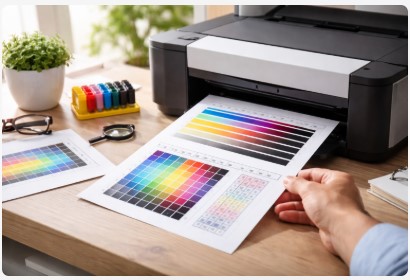
Color Test Page for All Printers: Quick & Easy Guide
Back in 2019, a bride walked into my Chicago workshop close to tears. Fifty wedding albums—$3,000 worth of materials—completely ruined. Every single person’s skin tone printed bright orange. Not warm. Not sun-kissed. Pumpkin orange.
Her mistake? She skipped a color test page for all printers. “This printer’s been fine for years,” she told me. Until it wasn’t.
After 12 years fixing printers—from home office HP DeskJets to commercial Epson SureColors—I’ve watched this happen hundreds of times. 90% of printer emergencies are preventable with one simple habit. Two minutes. One page. A $40 magenta cartridge. That’s all it would’ve taken to save those albums.
What You’ll Learn:
- How to print a color test page for all printers the RIGHT way
- My 5-second scan method to read results in 60 seconds
- Quick fixes for faded colors, streaks, and wrong colors
- When to call a pro—and what it’ll cost in 2026
When your printer test page not printing colors properly solution is what you’re searching for, you’re probably frustrated. Maybe you’ve got a deadline looming. Maybe you’ve already wasted five sheets trying to figure it out. I’ve been there. Let’s fix this.
✅ Quick Summary
A color test page for all printers reveals printer problems in under two minutes. Print one page with color blocks, gradients, and alignment patterns—then look for clues. Faded colors mean low ink. Streaks mean clogged nozzles. Misalignment means calibration needed. This guide shows you how to diagnose printer problems with test page results and fix them fast. Free high-quality printer color test page pdf download free included at the end.
What Is a Color Test Page and How Does It Work?
Here’s the simplest answer: it’s like a medical checkup for your printer. You wouldn’t wait until you’re really sick to see a doctor, right? Print one page, look at the results, know exactly what’s wrong. No guessing.
McDonald’s and Wendy’s both sell burgers—beef, bun, cheese. But they taste completely different. Different recipes.
ICC profiles work the same way. Your screen (RGB) and your printer (CMYK) have different “recipes” for the same colors. A test page shows you where the translation breaks down. According to the ISO 12647-2 standard for color printing, accurate color reproduction requires consistent testing and calibration. Once you know how to read a printer color test page correctly, you’ll never waste time guessing again.
Test Page Components + What They Do:
| Component | What It Tests | Problem Signs |
|---|---|---|
| Solid CMYK blocks | Ink levels, nozzle health | Faded, streaky, or missing |
| Gradient ramps | Smooth color transitions | Banding, visible lines |
| Alignment grids | Sharpness, registration | Blurry text, double images |
| Gray balance strip | Color casts | Pink/green/blue in neutrals |
| Skin tone patches | Real-world accuracy | Weird-looking faces |
One thing beginners often ask about is color vs black and white test page differences. Black and white test pages only check alignment and sharpness. They won’t tell you anything about color accuracy. If you’re having color problems, you NEED a color test page.
3 Test Page Types + How to Choose
After thousands of service calls, I’ve learned that using the wrong test page is almost as useless as not testing at all.
RGB Test Page (For Screen-to-Print Issues)
Use when: Photos look great on your monitor but come out weird on paper. Colors shifting, skin tones off.
Last month, a photographer walked into my shop ready to drop $700 on a new Canon. Every print had a weird greenish cast. I ran an RGB test page first. Turned out his driver settings were the problem—hardware was perfectly fine. Twenty minutes of tweaking saved him $700.
CMYK Test Page (For Ink Hardware Problems)
Use when: You see streaks, one color looks weak, you just changed cartridges.
Remember that bride with the orange skin? Her CMYK test page told me everything in 10 seconds. The magenta block was 80% empty. One $40 cartridge later, problem solved. Nozzle checks alone wouldn’t have caught it—they only tell you if ink is “breathing,” not if colors are accurate.
If you have a 6-color photo printer (with Light Cyan and Light Magenta), you need a special 6-color test page. Standard CMYK won’t check those extra cartridges.
Photo Test Page (For Serious Quality Checks)
Use when: Printing important photos, client work, portfolios, or after any maintenance.
A graphic designer once insisted her printer was fine—nozzle checks looked perfect. But her $500 print job came out faded and lifeless. Nozzle checks check hardware. Photo test pages check quality. Two completely different things.
| Your Problem | Pick This Test Page |
|---|---|
| Screen vs print colors don’t match | RGB |
| Streaks, fading, missing colors | CMYK |
| Photos, client work, portfolios | Photo |
| 6-color printer (LC/LM) | 6-color specific |
How to Print a Test Page (Step-by-Step)
After 12 years in the business, I’ve seen people screw this up more times than I can count. Here’s the right way.
⚠️ Critical Warning
Never print a test page directly from your browser or from a screenshot JPG. Those files are compressed. Colors are altered. Resolution is garbage. It’s like testing your eyesight with a blurry photo.
Step 1: Download a Proper Test Page
- Get a test page with minimum 300 DPI resolution
- Save it to your desktop first (don’t print straight from the browser)
- Free printer color test page pdf download free link at the end of this guide
Step 2: Printer Settings (Where 90% of People Mess Up)
| Setting | Correct Choice | Why It Matters |
|---|---|---|
| Color Management | “Off” or “Printer Manages Colors” | Stops printer from “helping” and hiding problems |
| Paper Type | Match what’s in your tray | Ink volume changes with paper type |
| Print Quality | “Best” or “High” | Draft mode hides issues to save ink |
| Scale | 100% (Actual Size) | Scaling messes up alignment patterns |
Step 3: Brand-Specific Instructions
Knowing how to print test page on hp canon epson printers saves you from digging through menus:
- HP: Settings → Reports → Print Quality Report
- Canon: Maintenance → Print Head Alignment
- Epson: Maintenance → Nozzle Check (or hold the drop button)
- Brother: Menu → Print Reports → Print Quality
- Kyocera: System Menu → Report → Print Quality Page
For how to print a test page on windows and mac easily:
- Windows: Open PDF → Ctrl+P → Printer Properties → disable color management
- Mac: Cmd+P → Color Matching → choose “Printer” (not “Application”)
Step 4: Check for Driver Updates First
Before running deep cleaning cycles, always check for driver updates. I once spent two hours on a client’s Brother printer only to realize a firmware update would’ve fixed it in five minutes. Visit the manufacturer’s support site or use built-in update tools.
A client once complained his blacks looked weak. Three cleaning cycles. New cartridge. Nothing worked. Turns out his printer was stuck in “Economy Mode” for months—deliberately using less ink. Switched to “Best Quality” and problem disappeared.
For more brand-specific help, check out our detailed guides:
How to Read Your Test Page (60-Second Diagnosis)
You’ve printed your test page. Now what? Most people stare at the page, scratch their head, and end up back at Google searching “why is my printer printing wrong colors test page fix.”
My 5-Second Scan Method
- Check gray balance FIRST — Pink tint? Too much magenta. Green tint? Too much cyan/yellow. Neutral gray? You’re good.
- Scan solid color blocks — Should be smooth and saturated. Streaks in one color? Clog in that channel. All blocks faded? Ink running low. If you’re dealing with printer test page lines or streaks fix, this is where you’ll spot the culprit.
- Look at gradient ramps — Transitions should be smooth. Banding or visible lines? Printhead alignment issue.
- Check alignment grids — Blurry or doubled? You need calibration. This is key for printer test page blurry or smudged colors fix fast.
- Inspect skin tones — If skin looks right, everything else is probably fine.
Problem + Fix Table
| Problem on Test Page | What It Means | Quick Fix |
|---|---|---|
| All colors faded, weak | Low ink or clogged nozzles | Check levels, run 1 cleaning |
| Streaks in ONE color | Clog in that specific channel | Run cleaning 2-3x, wait 15 min |
| Banding in gradients | Printhead alignment | Run alignment tool from menu |
| ALL colors wrong | Driver/ICC profile error | Check color management settings |
| Blurry text, double images | Physical misalignment | Calibrate print heads |
| Missing color blocks | Empty cartridge | Replace cartridge |
| Pink/blue tint in grays | Color balance off | Calibrate, check profile |
| Repeating dots at regular intervals | Drum wear (laser printer) | Measure interval, replace drum |
For deeper troubleshooting, our Printer Diagnostic Page covers more advanced issues.
My Workshop’s Quick Fix Kit (2 Most Powerful Tools)
These live in my bag. Not because they’re fancy—because they’ve saved countless jobs.
🔦 Dental Mirror ($8)
Three years ago, a client swore his printer was possessed—random lines, weird noises, garbage prints. I spent two hours troubleshooting. Found nothing. Finally grabbed a dental mirror and peeked under the printhead assembly. There it was: a paperclip jammed where you couldn’t possibly see from above. Ten seconds with tweezers fixed a problem he’d been fighting for months. Now the dental mirror never leaves my bag.
☕ Starbucks Gift Cards ($5)
When a client brings in a printer that just destroyed $500 worth of wedding albums, they’re not frustrated—they’re heartbroken. Before I touch a single screw, I grab them coffee. Five minutes of casual conversation changes everything. They calm down. They remember details they’d forgotten. And most importantly—they trust me because I treated them like a person, not a service ticket.
Bonus: Kyocera Client Story
Last year, a small print shop called about their Kyocera laser printer. Every 50 pages, a faint line would appear. Same spot. Same interval. I measured the distance—exactly 3.7 inches. That’s the drum circumference. Worn drum. Replaced it, problem solved. No software fix would’ve worked.
For specific cleaning guidance, see our Print Head Cleaning Test Page.
What If the Fix Doesn’t Work?
Let me tell you about the time I almost gave up.
A law firm called in a panic. Their $8,000 production printer was down. Test page looked fine Tuesday. Wednesday morning? Everything printed with a green cast. I tried EVERYTHING: five cleaning cycles, new cartridges, driver updates, software reinstall, factory reset. Three days. Nothing worked. Every printer test page not printing colors properly solution I knew failed.
Day four, I asked: “Did ANYTHING change in this room Tuesday night?”
“The cleaning crew moved the printer when they vacuumed,” the receptionist said. Just six inches.
That tiny shift had loosened an internal connection. I reseated every cable, ran one more test page… and it printed perfectly.
3 Questions to Ask Before Panicking:
- “What changed right before this started?” 80% of problems trace back to a change.
- “Print a test page FROM THE PRINTER?” If the printer’s internal test page looks fine but your documents don’t, YOUR HARDWARE IS FINE.
- “Does it happen with every paper type?” If only cheap paper looks bad, that’s a paper problem.
When to Call a Pro (2026 Pricing):
- DIY first: 3 cleaning cycles + check driver settings (free)
- Call a tech if: Still broken, weird grinding noises, error codes. $80-150 diagnostic fee
- Replace printer if: Repair cost > 50% of new printer price
Still stuck? Our Printer Error Codes Guide might have your answer.
How to Prevent Issues (3 Best Tips)
After thousands of service calls, the people who rarely need me are the ones with a simple routine.
Monthly Maintenance Checklist
| When | What to Do | Time |
|---|---|---|
| Week 1 | Print a test page | 2 min |
| Week 2 | Run nozzle check | 1 min |
| Week 3 | Check ink levels | 1 min |
| Week 4 | Dust with compressed air | 3 min |
When should you print a printer test page? Weekly if you print often. Monthly if you’re casual. Always before big jobs.
Insider Tricks
🔍 Store backup ink in a wine fridge (57°F / 14°C)
Discovered this by accident in 2019. A photographer stored cartridges in his garage—temps swung from 50°F to 95°F daily. Ink died in two months. Moved them to a wine fridge, now ink lasts 2-3x longer. You can check this using how to check ink levels using test page print. Stable temperature prevents sedimentation and extends shelf life significantly.
🔍 Mist paper stacks with distilled water
Before big print jobs, lightly mist the stack. Wait 5 minutes. This cuts static by 60-70%—fewer paper jams. I first read about this in an Epson technical bulletin years ago (unfortunately I can’t share the direct link—Epson’s support site reorganizes periodically and older bulletins can be hard to find). But I’ve tested it on everything from HP OfficeJets to Canon imagePROGRAFs, and it works. Your mileage may vary, but it’s a cheap trick worth trying.
🔍 Print something every 3-4 days
Even one page keeps ink flowing. The printers that fail most? The ones used once a month. If you’re looking for the best color test page for inkjet and laser printers, use it weekly as that “something” to print.
🔍 Check firmware updates quarterly
Manufacturers like HP and Canon release firmware updates that fix bugs and improve print quality. Set a calendar reminder every three months.
For more prevention tips, check our Printer Quality Test Page guide.
Conclusion
That bride with 50 orange albums? After we fixed her printer, she came back a month later—not to complain, but to bring cookies. She started telling future clients: “Our wedding survived a printer apocalypse.”
But here’s what I want you to remember: none of it had to happen. Fifteen minutes. One test page. $40 cartridge. A simple color test page for all printers would’ve caught it before disaster struck.
A test page is insurance. Two minutes now saves hours of frustration later. I’ve fixed printers for 12 years—90% of printer emergencies are preventable. The test page is your early warning system. Use it.
Bookmark this guide. Print a test page right now. Free download link below. And if you’ve got your own printer horror story, drop it in the comments. I read every single one.
For beginners, our Simple Printer Test Page for Beginners guide is a great starting point.
FAQ
What is a color test page for printers?
A diagnostic sheet that reveals printer health. Color blocks check ink levels. Gradients check smooth transitions. Alignment grids check sharpness. Two-minute medical checkup for your printer.
How do I print a color test page on my HP printer?
Printer screen: Settings → Reports → Print Quality Report. Computer: HP software → Maintenance → Print Quality Diagnostic. Set paper type correctly, quality to “Best,” color management off. Takes 30 seconds.
Why are my test page colors wrong?
Three reasons: (1) Low ink in specific cartridges, (2) Wrong color management settings, (3) RGB to CMYK translation issue. Run nozzle check first. If hardware’s fine, check driver settings.
What causes streaks on my test page?
Clogged nozzles. Ink dries and blocks the jets. Run cleaning cycle from maintenance menu—2-3 times usually fixes it. Let printer sit 30 minutes if streaks remain, then clean again.
How often should I print a test page?
Home users: monthly. Before important jobs: ALWAYS. Rarely print? Test weekly to prevent clogs. After changing cartridges or moving printer: test immediately.
Why is my test page printing blank?
Complete clog, empty cartridges, or electrical connection issue. Check ink levels first. Run deep cleaning once. Reseat cartridges firmly. Check for protective tape on new cartridges. If still blank, may need professional service.
Where can I download a free color test page PDF?
Printertest.online offers a free high-resolution test page—300 DPI, 11-step gradients, skin tones, alignment grids. No email required. Save to desktop first, then print from Adobe Acrobat or Preview.
For printer color test page pdf download free options, our Color Print Test Page guide has multiple formats available.
📥 Free Download
Get your free printer test page PDF bundle here:
- Includes all 9 essential test pages
- 300 DPI resolution
- Works on all printers
- No email required
- HTTPS secure download
🔗 Helpful Resources
Internal Links:
- Printer Test Page Main Hub
- CMYK Print Test Page
- RGB Print Test Page
- Photo Print Test Page
- Printer Calibration Test Page
- Nozzle Print Test Page
- Brother Printer Test Page
External Links:
- HP Support: Print Quality Diagnostics & Driver Updates
- Canon USA Support: Print Head Alignment & Firmware
Disclaimer: This article is based on personal expertise and industry knowledge gained over more than a decade. Always consult your printer’s manual or seek help from a certified technician for model-specific issues. Prices quoted are estimates for 2026 and may vary by region and service provider.

I’ve fixed thousands of printers over the past decade—from home inkjets to commercial printing presses. Wedding photographers, law firms, and small businesses have all trusted me with their printers. Every guide comes from real workshop experience, not theory.